
I'm listening to Leonard Cohen's Ten New Songs--he was in his late sixties when the album came out in 2001. I just finished reading Wounded, a novel by Percival Everett. The protagonist is a horse rancher who describes himself as old as dirt. Today I saw Crazy Heart, the new film in which Jeff Bridges plays a 57-year-old country singer alcoholic named Bad Blake. I listened to John Lee Hooker for nearly 3 hours straight while writing recently, and at the Getty the other day, I couldn't stop staring at photos of men working dangerous jobs--building the Empire State Building, trying to stop oil fires, laying bricks. The title of the exhibit was The Worker. I felt more affection for those images of men covered in coal dust then for the photos of secretaries and burlesque girls--even though I've been both of those.
These men are the people, the characters, and the voices that resonate most with me in the past months. I'm a 30-year-old blonde writer dancer woman with a Berkeley-feminist childhood and a pretty face, and the only people who seem to make any real sense to me right now are not just men, but men anywhere from 10-30 years older than me.
A psychologist would want to know more about my father. Blah blah blah. A feminist literary theorist would blame a phallogocentric culture with no true female logos. A historian might point out that women really weren't allowed to MAKE art unless they were crazed geniuses for most of Western history, and that when they did it anyway, they were suppressed or underappreciated. I understand this context, and I'm, of course, fascinated and humbled by it.
But tonight, I'm more interested in figuring out how to write in the world of Henry Miller without being called a "female version" of Henry Miller. And what to do about having a soul that seems strangely more like Tom Waits' or Henry Miller's than Erica Jong's.
I trust, love, and admire a goodly collection of women writers and artists. I think SARK has flouted the gendered demands of our culture with a wisdom and courage that is stunning. I read and wish I could have been roommates with Anais Nin. Sophie B. Hawkins is a hero of truth-telling and self-aware, mature sexiness. But has there been anyone since the 60s who was truly celebrated, in public, as a bad girl with frizzy hair and an un-Hollywood body who played guitar and drank whiskey? I feel sad tonight about the condition of gender. I feel that these old fart male artists are more my friends than the women I know, because they are less afraid of the world than most of the women I know. Everyone is dishonest. But in Crazy Heart, Bad Blake has at least one moment of wasting no time on image-maintenance in situations when it could have "helped" him to be more strategic--he tells his longtime agent "fuck you," does an interview without buttoning his shirt, and once he decides to get sober, does no grandstanding. John Hunt, Everett's protagonist in Wounded, always knows when he's lying, which means that he's got a constant self-awareness, if not a mandate to offer all his information to everyone. I used to feel some pity for men that they had to wear their sex organs on the outside, but now I am jealous. It's not quite penis envy, it's more like forced-honesty-envy.
Two nights ago I climbed into a limo with nine people who were dressed impeccably for a night out in Hollywood--men in nice shirts, women in sexy skirts, heels, makeup, perfect breasts. Lindsey and I were drunk on cheap Smirnoff, and we'd been in my Dollhouse talking and writing in our pajamas when we got a phone call from her friend and the whole night turned around. We didn't change our clothes, and on the ride into the hills, Lindsey said, "Ness, can you sum this up, the whole thing, everything up until now?" I was sprawled on the floor of the limo with my Target-bought Ugg knock-off boots balanced on the doorhandle and my ski-jacket halfway unzipped.
I said:
"Ok, I'll sum this up.
(A) Big Bang
(B) Dinosaurs
(C) Imperialism
(D) The Avant-Garde."
Riz Story, to my right, said, "I like that." Mark Batson, to my left, said, "Girl, wow."
Lindsey high-fived me, said, "Yes," and the women said nothing. Why? I don't know. They didn't listen because they were dressed up and I was in pajamas? They didn't know what I was "trying" to do? I really don't know.
I want a new way to be Woman, and I think Linz and I are stumbling towards it. As much as I admired Crazy Heart, I'm sick of characters like the writer Maggie G. plays, who falls for the bad boy Bad Blake and then has to self-protect when he does some inevitable destruction. Bah. I didn't buy it for a second--a woman like that would only be lightly curious, not truly turned on, by the darkness her lover saw on the edge of town, no matter how turned on she might be in the bedroom. It seemed there was a message about women there, and especially about mothers: all that darkness just can't enter the home where a child is being raised, and it is the Mama who will make sure of it.
So maybe that is the source of my identification with the alcoholics, the tortured bald poets, the deviant exiles and the truth-telling old men: my babies are stories, which actually need that darkness to live, and not real live children, whom it might destroy?

This is a picture of me, just before going onstage at the Great Boston Burlesque Expo, a very long and shockingly brief three years ago. This was my least obviously, and most problematically, political piece of burlesque. To most, it probably just looked silly. But to people who know the history of burlesque, my dancing to Beyonce's "Work it Out" from the Austin Powers soundtrack in a platinum afro wig was absolutely un-PC, even tasteless. I'll say it was patently irreverent to the fact that neo-burlesque is often conservatively crammed with identity politics. I was trying to do real work, to rustle up some awareness of the relationship between racial prejudice and hierarchical aesthetics in burlesque. Using a song from a parodic, pseudo-retro movie was supposed to underscore this. The hip crowd of neo-burlesque in Boston was predominantly white a few years ago, just like the middle-class crowd supporting old-school burlesque was white, and that's stupid and boring, and it should make people feel bad when they think about it. They don't have to read a lot of sociology or Marxist theory to understand that the social relations that determine who gets to be considered sexy, and how they are considered so on stage (demure Asian, raunchy German, etc.), haven't changed much in sixty years, that there's a prejudice inherent to and unchallenged by the system of retro-aesthetics, and that that's a problem. My work was simple: to make this bubble up from the group unconscious by breaking a few rules. My work that night just so happened to also be very, very fun for us all.
The first CD I owned was Dire Straits "Brothers in Arms." I'll explain that some other day, maybe. But I will never forget the confusion I felt when I realized (as a seven-year-old) that the song "Money for Nothing" was actually making fun of the industry of pop music, and that Dire Straits were looking in on their own lifestyle--"oh, that ain't workin', that's the way you do it, get your money for nothing and your chicks for free"--through the voice of a warehouse laborer who had to "install microwave ovens, make custom kitchen delivere-e-e-e-eeees." The guy who installed microwave ovens wanted to be a rock star. It seems obvious why, and yet, everyone knows that making music, touring, etc., is also a job. A job that some people have hated enough to die about.
One of the great American prejudices about work itself, it seems, is that work must, does, suck. SARK has been trying to combat this notion for many years by helping people, through her writing and workshops, to choose creative jobs, start creative companies, finish their masterpieces. She has, in fact, an almost zero-tolerance policy for not liking one's choice of work. The way I think of this is: all work will have problems, but if we're lucky, we get to choose the work that has problems we are more able or amenable to dealing with. This is like choosing a life partner--you do not expect their perfection, only that their flaws are the kind you can live with, understand, maybe even help. Of course, the ability to choose one type of work over another is a luxury that was not afforded blacks, women, poor whites, Native Americans, gays, etc., over the course of our history, so now, for anyone who does have at least a grasping glimpse of that kind of choice, it does seem ridiculous to choose work one doesn't like at least a little. Of course, because American capitalism fails so miserably, the volume of people trapped by lack of options, who do not have the choice to do something they don't hate, is huge, insane, and embarrassing.
Yet somehow we are not as curious about this problem as we might be. At the Getty, I stared at a series of photographs documenting the rural poor from the 1930s which had been commissioned by the Farm Securities Administration. There were photos documenting life in temporary work camps, which had also been paid for by the government. This seemed like a very important character change, from a depression-era government sending photojournalists out into the dark spaces of the country and starting the movements for social change, to what I see now as a government desperately involved in image-maintenance and secrecy. I got confused when thinking about the "honesty" of the photographs--seemed like faster shutter speeds led to less "posing" as photography got more sophisticated and common, but then, more photography has lead to a culture of people who are posing at all times? We think we're closer to the the "truth" of something like an oil cap explosion out in Kuwait, because a telephoto lens can get us there, but actually, we'd be dead if we were as close as the picture seems. So the truth in the photos is as problematic as the truth of language--we are always in some way removed from the object we're trying to discover/reveal. The "uncovering" of work conditions through photojournalism, while important and necessary, is also a kind of fiction. That we are not even pursuing that problematic level of truth and transparency in our current media scares me.
A few weeks ago, at a tiny nonprofit in Korea Town, the Street Sweeper Social Club and the Nightwatchman played rebel music for us. (If you never go to any of my other links, go to those. Boots Riley and Tom Morello are heroically fighting the good fight.) We yelled and pumped our fists and donated money in solidarity with CORT guitar workers from South Korea, who have been the victims of many unfair labor practices. At the end of the night, a large group of workers who had flown from Korea to be a rallying presence at the NAMM convention sang their own song, and I was struck again by the removal I felt: I felt the TRUTH of injustice, and the truth of solidarity, and the truth of urgency, but I couldn't even understand the language of the song, and I'd never heard of CORT guitars until that week. I hated myself for being uninformed. I found out that many CORT guitar workers consider themselves artisans, not just laborers, and that the rhetoric of the evening had been all jumbled: a fight for worker's rights slamming up against demands for recognition of their work as art. One musician even apologized for buying the CORT guitar he was playing, just before he praised the craftsmanship. At the end of the night, when we all had been singing "Rebel Song" together, Tom Morello yelled to us, "Take it easy, guys, but TAKE IT." And he offered some grace in all this confusion: the grace of bashing on.
When I'm writing, I call it working. When I'm dancing, I call it working. When I'm listening to Street Sweeper Social Club, I call it working. When I work out, I meditate on how my body can better guide my work, and when I sit in the Dollhouse drinking tea and reading, I'm still working. When I edit someone else's manuscript I'm working. When I wear a T-shirt I bought at a Critical Resistance event instead of the mall, I'm working. Some of this working brings in money, some of it not. Some work is more pleasurable than other work. Some work makes more obvious change in the world around me. Some work is constantly undone, redone, and undone again.
The other night, a man I'd just met asked me what I "do for fun." I actually laughed at him--first, for asking such a question. Then, I thought of that Dire Straits song, and how I don't feel some sad need to separate "fun" from "work" anymore. "I read a lot," I said. He was predictably disappointed. I wish I'd told him I installed microwave ovens for fun. Our conversation was over before it began, so I might as well have left him with the image of an activity everyone considers boring (and absurdly anachronistic!) labor appealing to a cute young thing like me as a hobby.
Here's what will happen next time:
Man: So what do you do for fun?
Me: It's been a long time since someone asked me that question. I like to install microwave ovens, you know, like, make custom kitchen deliveries.
Man: What?
Me: What?
Man: Did you say microwaves?
Me: Microwave ovens. They cook food faster than regular ovens?
Man: Um.
Me: But, most people know how to install them on their own now, so my hobby's become kind of a niche, underground thing, you know?
Man: Okay, well, you have a good night.
Me: Oh, I intend to.
This is not a review. After many hours of discussion of Terry Gilliam's (and Heath Ledger's, and Johnny Depp's, and Jude Law's, and Colin Farrell's) The Imaginarium of Dr. Parnassus, Max and I have decided to quit. Trying. To make sense.
Our original idea was to write a blog together that would include three things: the movie, the riff from Black Sabbath's "Supernaut," and a third thing we can't remember now. So we'll be writing about these three things together, always leaving out the third, which keeps in time nicely with the rhythm and logic of Dr. Parnassus.
You don't understand, and neither does Max. Although, he is quite confident that he DOES understand the movie. I am confident that he understands Black Sabbath, at least better than I do. The fact that our third object of discussion has escaped us both is sad. We both understand sad.
Some things about the movie: it features a villain, who is a relentless capitalist, and who leads supposed friends to ruin. This villain is not the devil, although, The Devil does feature prominently in the film.
Max: I like him.
Vanessa: Who? Which?
M: The Devil. Not the capitalist.
V: Ok. I like him too.
M: He's a little disruptive, but he always has jazz playing.
V: Actually, I thought we hated him because what he likes best is status quo.
M: Oh that's right, I hate him, don't I? (suddenly in a British accent)
V: I thought so. At least I used to think so. I meant that I like Tom Waits.
We are sitting under a blue and red neon sign that says "OPEN" out to the street. This means at least two things to me: (1) other people could eat here, at the Vegan Express, and, (2) we're hyperactively conscious of signs and symbols after being in the Imaginarium.
But back to to Black Sabbath. There's a riff, which opens the song "Supernaut," that goes waaauh-wauh-wauh-wauh-wauh-waauh-waauh-waauh. Max says Frank Zappa says this is the Ultimate Riff. This means: this is perfectly stupid, and holds very intense power. Max says a riff is something that's cyclically repeated, allowed to build on itself. It's more like a spiral than a circle. The power is a kind of hypnosis. The only difference between a riff and Gregorian Chant is that a riff ends sooner, brings you somewhere new, fast.
Which, now that we think about it, is what The Imaginarium of Dr. Parnassus does. (Vanessa says: I knew I wanted to put those things together. I wish we could remember the third thing. I really do.)
Here's what happened:
Vanessa was lying on the couch crushing Anthony. Max sat across the room.
the other power that riffs have is that they can introduce an idea or a feeling to you with a kind of viceral immediacy. The sad thing about heavy metal is that sometimes these are really absurd ideas about dragons, but sometimes they are things like "I want to reach out and touch the sky" which is a cliche, but with a metal riff it achieves a level of profundity. We are confronted with objects and ideas in the Imaginarium that have an evocative power, but are not directly symbolic or representational in the ways we're used to. This makes them profound, even though we can't explain their "meaning." Also, Max's right temple started throbbing during the movie and hasn't stopped. A riff is a partially melodic, partially harmonic, repetitive motif that sometimes doesn't do all of what we've described. Sometimes it only conjures body sensations, or is used in place of more developed music, without explanation. Critics have accused The Imaginarium of being this second type of riff. We disagree, and think it much more like Black Sabbath's.
Vanessa: Max, let's co-write a blog about Something-We-Won't-Remember, Dr. Parnassus, and Black Sabbath.
Max: Yeah! Although I don't see what Black Sabbath has to do with it.
Vanessa: Oh, it does.
Max: Good. Yes.
(Exeunt, to Vegan Express)
At Vegan Express, Vanessa ate a mock-chicken wrap. Whole wheat lavash bread, romaine lettuce, tomatos, avocados, and a protein source that had been perfectly fried in kamut. In a small silver gravy boat, waaah-wauh-wauh-wauh-waaauh, a savory tahini white sauce.
Max thinks this is all very funny.
Vanessa: I'd like to say something that means something, and then stop.
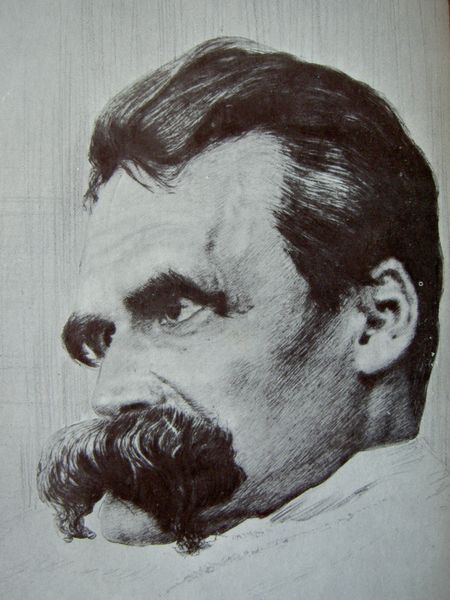
Nietzsche:
My idea is that every specific body strives to become master over all space and to extend its force (--its will to power:) and to thrust back all that resists its extension. But it continually encounters similar efforts on the part of other bodies and ends by coming to an arrangement ("union") with those of them that are sufficiently related to it: thus they then conspire together for power. And the process goes on--
from The Will to Power, s.636, Walter Kaufmann transl.
The Will to Power was the 3rd thing.


