
This is a picture of me, just before going onstage at the Great Boston Burlesque Expo, a very long and shockingly brief three years ago. This was my least obviously, and most problematically, political piece of burlesque. To most, it probably just looked silly. But to people who know the history of burlesque, my dancing to Beyonce's "Work it Out" from the Austin Powers soundtrack in a platinum afro wig was absolutely un-PC, even tasteless. I'll say it was patently irreverent to the fact that neo-burlesque is often conservatively crammed with identity politics. I was trying to do real work, to rustle up some awareness of the relationship between racial prejudice and hierarchical aesthetics in burlesque. Using a song from a parodic, pseudo-retro movie was supposed to underscore this. The hip crowd of neo-burlesque in Boston was predominantly white a few years ago, just like the middle-class crowd supporting old-school burlesque was white, and that's stupid and boring, and it should make people feel bad when they think about it. They don't have to read a lot of sociology or Marxist theory to understand that the social relations that determine who gets to be considered sexy, and how they are considered so on stage (demure Asian, raunchy German, etc.), haven't changed much in sixty years, that there's a prejudice inherent to and unchallenged by the system of retro-aesthetics, and that that's a problem. My work was simple: to make this bubble up from the group unconscious by breaking a few rules. My work that night just so happened to also be very, very fun for us all.
The first CD I owned was Dire Straits "Brothers in Arms." I'll explain that some other day, maybe. But I will never forget the confusion I felt when I realized (as a seven-year-old) that the song "Money for Nothing" was actually making fun of the industry of pop music, and that Dire Straits were looking in on their own lifestyle--"oh, that ain't workin', that's the way you do it, get your money for nothing and your chicks for free"--through the voice of a warehouse laborer who had to "install microwave ovens, make custom kitchen delivere-e-e-e-eeees." The guy who installed microwave ovens wanted to be a rock star. It seems obvious why, and yet, everyone knows that making music, touring, etc., is also a job. A job that some people have hated enough to die about.
One of the great American prejudices about work itself, it seems, is that work must, does, suck. SARK has been trying to combat this notion for many years by helping people, through her writing and workshops, to choose creative jobs, start creative companies, finish their masterpieces. She has, in fact, an almost zero-tolerance policy for not liking one's choice of work. The way I think of this is: all work will have problems, but if we're lucky, we get to choose the work that has problems we are more able or amenable to dealing with. This is like choosing a life partner--you do not expect their perfection, only that their flaws are the kind you can live with, understand, maybe even help. Of course, the ability to choose one type of work over another is a luxury that was not afforded blacks, women, poor whites, Native Americans, gays, etc., over the course of our history, so now, for anyone who does have at least a grasping glimpse of that kind of choice, it does seem ridiculous to choose work one doesn't like at least a little. Of course, because American capitalism fails so miserably, the volume of people trapped by lack of options, who do not have the choice to do something they don't hate, is huge, insane, and embarrassing.
Yet somehow we are not as curious about this problem as we might be. At the Getty, I stared at a series of photographs documenting the rural poor from the 1930s which had been commissioned by the Farm Securities Administration. There were photos documenting life in temporary work camps, which had also been paid for by the government. This seemed like a very important character change, from a depression-era government sending photojournalists out into the dark spaces of the country and starting the movements for social change, to what I see now as a government desperately involved in image-maintenance and secrecy. I got confused when thinking about the "honesty" of the photographs--seemed like faster shutter speeds led to less "posing" as photography got more sophisticated and common, but then, more photography has lead to a culture of people who are posing at all times? We think we're closer to the the "truth" of something like an oil cap explosion out in Kuwait, because a telephoto lens can get us there, but actually, we'd be dead if we were as close as the picture seems. So the truth in the photos is as problematic as the truth of language--we are always in some way removed from the object we're trying to discover/reveal. The "uncovering" of work conditions through photojournalism, while important and necessary, is also a kind of fiction. That we are not even pursuing that problematic level of truth and transparency in our current media scares me.
A few weeks ago, at a tiny nonprofit in Korea Town, the Street Sweeper Social Club and the Nightwatchman played rebel music for us. (If you never go to any of my other links, go to those. Boots Riley and Tom Morello are heroically fighting the good fight.) We yelled and pumped our fists and donated money in solidarity with CORT guitar workers from South Korea, who have been the victims of many unfair labor practices. At the end of the night, a large group of workers who had flown from Korea to be a rallying presence at the NAMM convention sang their own song, and I was struck again by the removal I felt: I felt the TRUTH of injustice, and the truth of solidarity, and the truth of urgency, but I couldn't even understand the language of the song, and I'd never heard of CORT guitars until that week. I hated myself for being uninformed. I found out that many CORT guitar workers consider themselves artisans, not just laborers, and that the rhetoric of the evening had been all jumbled: a fight for worker's rights slamming up against demands for recognition of their work as art. One musician even apologized for buying the CORT guitar he was playing, just before he praised the craftsmanship. At the end of the night, when we all had been singing "Rebel Song" together, Tom Morello yelled to us, "Take it easy, guys, but TAKE IT." And he offered some grace in all this confusion: the grace of bashing on.
When I'm writing, I call it working. When I'm dancing, I call it working. When I'm listening to Street Sweeper Social Club, I call it working. When I work out, I meditate on how my body can better guide my work, and when I sit in the Dollhouse drinking tea and reading, I'm still working. When I edit someone else's manuscript I'm working. When I wear a T-shirt I bought at a Critical Resistance event instead of the mall, I'm working. Some of this working brings in money, some of it not. Some work is more pleasurable than other work. Some work makes more obvious change in the world around me. Some work is constantly undone, redone, and undone again.
The other night, a man I'd just met asked me what I "do for fun." I actually laughed at him--first, for asking such a question. Then, I thought of that Dire Straits song, and how I don't feel some sad need to separate "fun" from "work" anymore. "I read a lot," I said. He was predictably disappointed. I wish I'd told him I installed microwave ovens for fun. Our conversation was over before it began, so I might as well have left him with the image of an activity everyone considers boring (and absurdly anachronistic!) labor appealing to a cute young thing like me as a hobby.
Here's what will happen next time:
Man: So what do you do for fun?
Me: It's been a long time since someone asked me that question. I like to install microwave ovens, you know, like, make custom kitchen deliveries.
Man: What?
Me: What?
Man: Did you say microwaves?
Me: Microwave ovens. They cook food faster than regular ovens?
Man: Um.
Me: But, most people know how to install them on their own now, so my hobby's become kind of a niche, underground thing, you know?
Man: Okay, well, you have a good night.
Me: Oh, I intend to.
This is not a review. After many hours of discussion of Terry Gilliam's (and Heath Ledger's, and Johnny Depp's, and Jude Law's, and Colin Farrell's) The Imaginarium of Dr. Parnassus, Max and I have decided to quit. Trying. To make sense.
Our original idea was to write a blog together that would include three things: the movie, the riff from Black Sabbath's "Supernaut," and a third thing we can't remember now. So we'll be writing about these three things together, always leaving out the third, which keeps in time nicely with the rhythm and logic of Dr. Parnassus.
You don't understand, and neither does Max. Although, he is quite confident that he DOES understand the movie. I am confident that he understands Black Sabbath, at least better than I do. The fact that our third object of discussion has escaped us both is sad. We both understand sad.
Some things about the movie: it features a villain, who is a relentless capitalist, and who leads supposed friends to ruin. This villain is not the devil, although, The Devil does feature prominently in the film.
Max: I like him.
Vanessa: Who? Which?
M: The Devil. Not the capitalist.
V: Ok. I like him too.
M: He's a little disruptive, but he always has jazz playing.
V: Actually, I thought we hated him because what he likes best is status quo.
M: Oh that's right, I hate him, don't I? (suddenly in a British accent)
V: I thought so. At least I used to think so. I meant that I like Tom Waits.
We are sitting under a blue and red neon sign that says "OPEN" out to the street. This means at least two things to me: (1) other people could eat here, at the Vegan Express, and, (2) we're hyperactively conscious of signs and symbols after being in the Imaginarium.
But back to to Black Sabbath. There's a riff, which opens the song "Supernaut," that goes waaauh-wauh-wauh-wauh-wauh-waauh-waauh-waauh. Max says Frank Zappa says this is the Ultimate Riff. This means: this is perfectly stupid, and holds very intense power. Max says a riff is something that's cyclically repeated, allowed to build on itself. It's more like a spiral than a circle. The power is a kind of hypnosis. The only difference between a riff and Gregorian Chant is that a riff ends sooner, brings you somewhere new, fast.
Which, now that we think about it, is what The Imaginarium of Dr. Parnassus does. (Vanessa says: I knew I wanted to put those things together. I wish we could remember the third thing. I really do.)
Here's what happened:
Vanessa was lying on the couch crushing Anthony. Max sat across the room.
the other power that riffs have is that they can introduce an idea or a feeling to you with a kind of viceral immediacy. The sad thing about heavy metal is that sometimes these are really absurd ideas about dragons, but sometimes they are things like "I want to reach out and touch the sky" which is a cliche, but with a metal riff it achieves a level of profundity. We are confronted with objects and ideas in the Imaginarium that have an evocative power, but are not directly symbolic or representational in the ways we're used to. This makes them profound, even though we can't explain their "meaning." Also, Max's right temple started throbbing during the movie and hasn't stopped. A riff is a partially melodic, partially harmonic, repetitive motif that sometimes doesn't do all of what we've described. Sometimes it only conjures body sensations, or is used in place of more developed music, without explanation. Critics have accused The Imaginarium of being this second type of riff. We disagree, and think it much more like Black Sabbath's.
Vanessa: Max, let's co-write a blog about Something-We-Won't-Remember, Dr. Parnassus, and Black Sabbath.
Max: Yeah! Although I don't see what Black Sabbath has to do with it.
Vanessa: Oh, it does.
Max: Good. Yes.
(Exeunt, to Vegan Express)
At Vegan Express, Vanessa ate a mock-chicken wrap. Whole wheat lavash bread, romaine lettuce, tomatos, avocados, and a protein source that had been perfectly fried in kamut. In a small silver gravy boat, waaah-wauh-wauh-wauh-waaauh, a savory tahini white sauce.
Max thinks this is all very funny.
Vanessa: I'd like to say something that means something, and then stop.
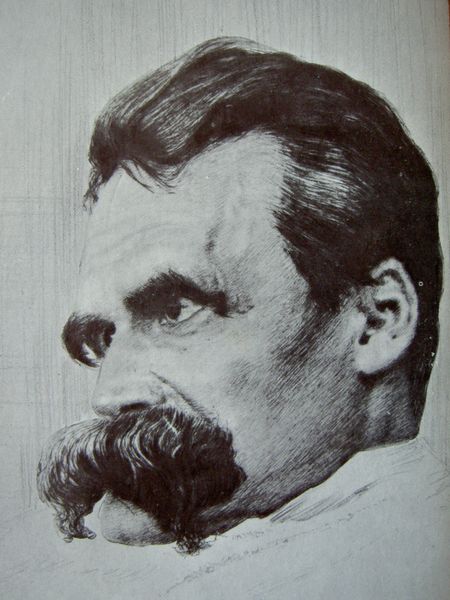
Nietzsche:
My idea is that every specific body strives to become master over all space and to extend its force (--its will to power:) and to thrust back all that resists its extension. But it continually encounters similar efforts on the part of other bodies and ends by coming to an arrangement ("union") with those of them that are sufficiently related to it: thus they then conspire together for power. And the process goes on--
from The Will to Power, s.636, Walter Kaufmann transl.
The Will to Power was the 3rd thing.
 I don't know the inner workings of Fox and so can't comment on the competition between all the animated shows on Sunday nights--I imagine the Simpsons stand a bit outside the ring, if Family Guy, American Dad, and The Cleveland Show are all in it. And I claim no authority on any of the shows except American Dad. I just don't have time to watch hit-or-miss TV, which is what most of it is. So what I offer here is a love letter, plain and simple.
Why is American Dad an exception to my tendency to ignore TV? Because it is more obsessed with American culture than it is obsessed with scatological humor, cynical send-ups, or itself as a show.
When I say the show is obsessed with American culture, let me be clear. I think Family Guy is also obsessed with our culture, but it is mostly obsessed with doing reversals of obvious values. Reversals, or jokes that rely on shock value, don't actually make real comment on culture. They simply reveal what is already there. It is wacky and shocking to have Peter wear S&M gear! But why? All that does is remind me that most Americans think S&M is weird, scary, and so, even with its minimal exposure nod as a joke, it stays taboo. American Dad, in general, is asking more difficult questions of obvious values. It does this through plotlines that, like the Simpsons once did, consistently return to real emotional concerns about family relationships and the way American families interact with issues of class, race, and gender. And it does this hilariously, by applying liberal coats of pitch-perfect absurdity.
In a recent episode called "My Morning Straight Jacket," Stan Smith becomes obsessed with My Morning Jacket's frontman Jim James. Through each season of AmDad the issue of Stan's inability to feel real feelings has surfaced as a barrier to his being close to, well, anyone, and is often the basis for great jokes. In this episode, the table gets turned. Stan feels so many feelings listening to MMJ he becomes a narcisistic, self-involved fan, who ignores his family (who are drowning, falling down the stairs, etc.) to live in his little solipsistic world with Jim James.
Francine, who at first is exasperated and wants the old Stan back, finally becomes his means to meeting Jim, as she flashes her breasts, crotch, and latent lesbianism at every level of security at a MMJ show. Of course it's funny that the sweet mom can become a trashy groupie, but what's especially wonderful is the moment when Stan, without any compunction, gets on his knees and thanks Francine's body for helping him. This is a revolutionary moment. The cliche goes: the husband becomes jealous of other men's eyes on his property, even as he benefits from the objectification of his wife. Here, the objectification still occurs, but Francine does not suffer for it, and Stan responds only with gratitude to her. Even more subtly, he responds to her body directly, thanking the "girls," (her breasts) and "ma'am" (her vagina) separately. This is a moment that suspends itself above familiar arguments about gender and sexuality and offers real hope in the potential for lovers to be conscious of the systems they are in, transcend or participate in those systems, and build intimacy with each other regardless. That kind of hope seeps through the show in nearly every episode, which is great anodyne to the cynical, heartless, jaded style of humor that is so ubiquitous now.
When Stan finally meets Jim James, the sweet moral we thought we were in for gets upended. Jim claims he's just another guy who puts his pants on one leg at a time, then backflips into a set of dungarees held by two flying llamas. The point is, who cares if Jim James is a god, a hippie, or my cousin? Stan has to learn to take the sense of excitement and joy he finds in the music of MMJ and use it to better his actual life, to deepen his relationship with his wife, not to devise bullshit fairy tales about his shared brain with his idol. American Dad isn't afraid to actually HAVE a moral to their story, which is something else I admire about the show.
That my humor tends to the surreal/absurd means that I love the packaging of AmDad's heart, and I will eventually write much more about its textural experiments with meta-fiction, with ahistoricity, and with pastische. For now I'm satisfied to know that snark hasn't totally won the battle for the airwaves.
Watch AmDad on Hulu!


